The New Testament
“Clobber Texts”

Despite the many debates over what the New Testament supposedly says about “homosexual" sin this next section is really not that long – honest! That’s because the New Testament actually has surprisingly little to say on the subject, although what it does say, I now believe, has often been badly mistranslated and badly misunderstood. And all it does say is through the pen of one man – the apostle Paul - in just three short passages in Romans 1:26-27, 1 Corinthians 6:9-10 and 1 Timothy 1:9-11.
However, if you just want a quick overview of my main points, just head over to my summary here.
And for those geeks, like me, who want to dive deeper, including a more detailed look at the surrounding cultural context and the meaning of the key Greek words please look at my long essay I’ll link here.
Please note - to examine this topic it was necessary to include occasional references to specific sexual activities (and a couple of explicit Roman murals from Pompeii)
What would Paul have known about same-sex relationships and sexual orientation?
We’re about to delve into what Paul wrote about same-sex relationships. But to inform our understanding of what he wrote I believe it’s important we first understand what Paul would have seen, read and known about same-sex relationships.

The following is a brief summary of what I found from my research of the available evidence. For further detail please see my essay which I will link above. I would also highly recommend Matthew Vines’ excellent and well-researched piece https://reformationproject.org/same-sex-marriage-homosexuality-biblical-world/ This is also comprehensively covered in the updated version of his God and the Gay Christian (see my Further Resources). Traditionalist evangelical scholars like NT Wright and Preston Sprinkle have argued there is literary evidence that same-sex marriages or marriage-like relationships were known to happen around the time Paul wrote. However, through a careful analysis of what those ancient texts actually say, I believe Matthew Vines demonstrates how they have misread and misunderstood them; that the supposed same-sex marriages described are all very different to the marriage relationships revisionists are advocating. Some were probably not sexual at all, e.g. Achilles and Patroclus' friendship actually seems to have been very similar to Jonathan and David's . The rest were either unequal and exploitative relationships and/or unfaithful and temporary. The one contemporary literary source pointing to a genuinely loving sexual relationship of two equal men, An Ephesian Tale, turns out to be a cautionary tale against pursuing such relationships. Further, it actually supports the position that such relationships were virtually unheard of and would have been universally condemned.
We cannot be certain exactly what Paul had seen of same sex sexual relationships. However, the available historical and literary evidence indicates that as a first century Jewish Roman citizen this is likely what he would have known:
-
All-male sexual activity was rife but all or virtually all known forms were selfish, promiscuous and exploitative: mainly slave masters having anal intercourse with their slave boys (or men), and (in Greek cities) pederastic older men sleeping with youths by arrangement with their fathers, as well as possibly some occasional male prostitution
-
There is no clear evidence of known faithful committed sexual relationships between free men of similar standing happening at that time
-
If they happened at all they were very rare
-
Even casual all-female sexual relationships were rarely spoken about, although they would have happened (frankly, no one was very bothered what two women got up with together anyway!)
-
There had been no known same-sex marriages
-
The odd writer like Plato had written about the idea of same-sex marriage-like partnerships but these were still unequal, exploitative relationships and most writers, including Plato himself, condemned them
-
The almost universal view was that all men could be content with sexual relations with women but some pursued sex with men out of a desire to widen their experience or an excess of lust - depending on your point of view!
-
Most secular moralists condemned sex with other men, because they considered sex should be preserved for marriage and preferably only to procreate children
-
But a large section of society accepted sex between men which complied with society’s accepted hierarchical norms, i.e., sex with slaves, pederastic youths or prostitutes
-
There was almost universal condemnation of sex between two free men of similar age and status because it treated the passive partner as if they were a “mere” woman
-
It was recognized that some men developed a greater taste for sex with other men than with women
-
But there is no evidence of any awareness that some men could only ever be satisfied with sex with other men
"Doesn’t Romans 1 condemn all gay sex as sinful rebellion against God’s natural order?"
What Paul said
Having thoroughly examined the evidence concerning this passage, I’m now convinced beyond any reasonable doubt that this is not what this passage teaches. I concluded that, contrary to how I'd previously understood it, the passage actually says nothing at all about lesbian sex and condemns only a particular egregious form of all-male sex. I set out below a summary of my findings and the main reasons for them. For a more detailed account, including a deep dive into the meaning of the passage’s key Greek words and concepts, like “nature”, “shame” and “purity”, please read my lengthy essay which I will link again here. I would also highly recommend James Brownson's scholarly chapters on these concepts in his book, Bible, Gender, Sexuality (see my Further Resources page)

Romans 1:18 - 2:1 says:
18. “The wrath of God is being revealed from heaven against all the godlessness and wickedness of people, who suppress the truth by their wickedness, 19. since what may be known about God is plain to them, because God has made it plain to them. 20. For since the creation of the world God’s invisible qualities—his eternal power and divine nature—have been clearly seen, being understood from what has been made, so that people are without excuse.
21. For although they knew God, they neither glorified him as God nor gave thanks to him, but their thinking became futile and their foolish hearts were darkened. 22. Although they claimed to be wise, they became fools and 23. exchanged the glory of the immortal God for images made to look like a mortal human being and birds and animals and reptiles.
24. Therefore God gave them over in the sinful desires of their hearts to sexual impurity for the degrading of their bodies with one another. 25. They exchanged the truth about God for a lie, and worshiped and served created things rather than the Creator—who is forever praised. Amen.
26. Because of this, God gave them over to shameful lusts. Even their women exchanged natural (physiken) sexual relations for unnatural (para physin) ones. 27. In the same way the men also abandoned natural (physiken) relations with women and were inflamed with lust for one another. Men committed shameful acts with other men, and received in themselves the due penalty for their error.
28. Furthermore, just as they did not think it worthwhile to retain the knowledge of God, so God gave them over to a depraved mind, so that they do what ought not to be done. 29. They have become filled with every kind of wickedness, evil, greed and depravity. They are full of envy, murder, strife, deceit and malice. They are gossips, 30. slanderers, God-haters, insolent, arrogant and boastful; they invent ways of doing evil; they disobey their parents; 31. they have no understanding, no fidelity, no love, no mercy. 32. Although they know God’s righteous decree that those who do such things deserve death, they not only continue to do these very things but also approve of those who practice them.
2 1. You, therefore, have no excuse, you who pass judgment on someone else, for at whatever point you judge another, you are condemning yourself, because you who pass judgment do the same things."
Paul was very probably paralleling here the Old Testament Canaanite chain of depravity with the Roman version his audience saw around them: turning away from the living God to worship idols. This led them to lose their moral compass and pursue lives of sinful, selfish excess without boundaries. So they went on to commit various wicked acts - promiscuous lustful sex (including lustful male homoerotic acts) and many other sins.


Paul was probably also alluding to the debauched practices at the court of the notorious recent ex-Emperor Caligula and possibly also the current emperor, Nero, with which his audience would have been very familiar. This included depraved sexual practices such as Caligula’s sex with his own sisters. He ended up being killed by being stabbed in the penis to which Paul possibly alludes to as getting what was “due” in their own body.

But Paul can’t have been only condemning sinful behaviours by those who’d turned to idols. That’s because in chapter 2 he turns tables on his Christian audience to accuse them of doing some of the same things.
What Paul meant - “nature”
The Greek word for nature which Paul uses here, physis, encompassed three forms - what was natural according to biology, social custom or inner nature. Paul is probably describing the homoerotic sex he refers to here as unnatural in all three senses. He uses the same Greek word "physis" ” in 1 Corinthians 11:14 when he discourages men from growing their hair long as being "unnatural" in the sense of against current social custom. (Even though the Old Testament often encouraged or praised long male hair e.g. Samson, Absalom and the Nazarites). However, we can’t and don’t apply what Paul described as “natural” in his day to test what’s morally acceptable today, because:
-
As we see elsewhere in the New Testament, Paul himself didn’t universally apply that as his moral litmus test ( if he did he would not have spoken in tongues or performed miracles which pagan Greco-Romans would have seen as unnatural )
-
We have very different understandings today about what is natural according to biology, social custom or inner nature.
-
If we today condemned all male gay sex simply because Paul described it as unnatural then to be consistent we should also insist men keep their hair short and women theirs long but under a hat in church (see 1 Cor. 11)
-
This doesn't mean we should just ignore whether things are "natural" according to biology, social custom or inner nature. But we should recognise what is "natural", at least socially, is not fixed for all time.
-
As Christians, we should avoid doing things that are out of step with social norms without good reason, as this just makes Christians look like weirdos and does not help promote the gospel (which underlaid Paul's point in 1 Cor. 11)
-
For Greco-Romans this meant men keeping their hair short. For us it will mean something different.
What he meant – the types of sex he was not condemning
Contrary to my original understanding, the only type of homoerotic sex Paul describes here were the acts of men “inflamed with selfish lust” for other men. This could not include a man having sex with another man within a faithful, monogamous partnership. That's because such sex does not proceed from excessive, self-seeking lust but from a loving, committed relationship.

Paul was not creating precisely defined new sexual laws like an updated Leviticus 18. He was singling out behaviour his church could see around them and which they themselves were tempted to or did take part in. The only male homoerotic sex known to be happening involved married men pursuing lustful sex on the side with boys and men under their control, mainly their slaves. So this is another reason why Paul could not have had in mind two men in a faithful monogamous relationships sleeping together - because such relationships were simply unheard of at the time.

Contrary to my original understanding, for the reasons summarised here, I'm now convinced that the female sex Paul condemned could not have been lesbian.
Lesbian sexual activities were rarely spoken about at the time. They would have happened occasionally, but no one condemned them until four centuries later.
The ancient Romans almost worshipped the penis as a symbol of fertility. Hence the phallic symbols and paintings you'll see everywhere if you visit Pompeii. (See the fine example below that I photographed on our visit there!) Our archaeologist-guide advised us that these were not signs to the nearest brothel (as commonly misunderstood) but signs of fruitfulness and blessing.
For the ancient Romans, the penis was central to sex since this is what gave sex its procreative potential – the key to the fruitfulness and blessings of sex as they saw it. So, for them, if it didn't involve a phallus, it wasn't really sex at all. Therefore, no one was very bothered about what two women got up to together and there is a lack of any condemnation of such activities within the contemporaneous literature (in contrast to various writers condemning male homoerotic acts)

Similarly, the Jewish Talmud from that time (which sets additional rules for Jews to follow) referred to mesolelet, the practice of two women rubbing their genitals together (tribadding). Whilst it didn't approve of it, it imposed no sanction. Most rabbis did not even think such lesbian sex damaged a woman’s purity to disqualify her from marrying a priest.

Furthermore, for over three centuries after Paul, all the early church fathers who discussed this passage agreed that Paul was referring to women having sex with men but in ways unacceptable to society at the time.
So, all the contemporaneous evidence points to the female sexual acts Paul was condemning in verse 26 as being heterosexual ones, motivated by excessive lust, which drove women to acts considered unnatural at the time. This may have included some copying their husbands by sleeping with their male slaves (possibly through anal intercourse to avoid pregnancy risks), which was certainly known to happen. In addition, he may have been referring to incest as seen in the court of the recent Emperor Caligula who had slept with his sisters. Also, he may well simply have been referring to sexual acts contrary to "nature" in being against social custom. This could have simply meant women taking the lead role in sex with a man, contrary to the then current hierarchical roles of men ruling over women - women on top! (As illustrated by one of the Roman murals below!)
We can't be certain exactly which female sex acts Paul was referring to, but all available evidence indicates these were heterosexual not homosexual activities.
There are no other passages in the entire canon of Scripture which even arguably condemn all-female sexual acts. Since it's pretty clear this passage doesn't condemn it either, we should accept that Scripture nowhere condemns sex simply because it is between two women.

I believe the lack of any condemnation of female homoerotic sex in Scripture should give us a strong clue that the condemnation of male homoerotic sex can’t have been simply because it involved people of the same sex.
Otherwise, lesbian sex would have been condemned somewhere and it just isn’t.
What Paul meant – the types of sex he was condemning and why
So, the fact that Scripture nowhere condemns any lesbian sex very strongly suggests that the reason why Paul occasionally condemned certain male “homosexual” acts can’t simply have been that it involved people of the same sex. Logically it also can't be because it involved anal sex, since nowhere does Scripture condemn this between a man and a woman. So, there must surely be other reasons why he occasionally condemned sex between two men.
The “shameful” conduct Paul describes in verse 27 was men so driven by lust for other men that they had promiscuous sex with other males outside the “natural” accepted gender roles of the time. Again, this description could not accurately describe men in faithful monogamous relationships sleeping together because this is not the driver for their sexual relations. But, again, Paul had no need to exempt from his condemnation homosexual men enjoying sex with other men within committed monogamous relationships, because all available evidence indicates such relationships were simply unknown.
This passage seems to me a clear expression of Paul’s first key Thessalonian principle of sexual ethics: “control your body sexually in a way that is holy and honourable, not in passionate lust like the pagans, who do not know God.” (1 Thess. 4:1-5). This appears to be the true reason why Paul condemned the homoerotic sex he describes in this passage.
When gay men today in faithful committed partnerships sleep with their partner I believe they are actually fulfilling Paul’s advice here (and in 1 Corinthians 7) by controlling their bodies in keeping sex within the sanctity and safety of that relationship, rather than pursuing promiscuous sex out of an excess of lust.

What does this passage teach us for today?
Romans 1 (and 2) still has much to teach us about faithfully following the true living God and not selfishly pursuing the gods of our own appetites, and checking that as Christians we do not fall into those same selfish, self-seeking habits that we condemn others for. Sadly, I believe, too many Christians today miss the point of Paul’s message and, just like his original audience, read into these verses a condemnation of the sins of others whilst failing to see the spotlight on our own selfish habits and lifestyles – sexual or otherwise. I've certainly been guilty of that at times. And this message also needs to be understood in the light of what follows in chapter 3: that all of us have fallen short and so we all need God’s freely given grace to be justified through faith in Christ.
"Don’t 1 Corinthians 6:9-10 and 1 Timothy 1:9-11 condemn all gay sexual acts, and warn they will send people to hell?"


No. Again, having thoroughly examined the evidence concerning these passages, I’m now convinced this is not what they teach. My conclusion was that Paul was addressing only a particular abusive form of all-male sex. I set out below a summary of my findings and the main reasons for them. For a more detailed account please read my lengthy essay which I will again link here.
What Paul said
Note first what Paul and the other New Testament writers didn’t say - homosexual acts are not included in any of the other 21 vice lists in the New Testament; only in these two passages. This itself should give us reason to review if we've been thinking that the New Testament regarded homosexual conduct as some stand out sin, as opposed to, say, greed, anger and pride. It just didn't.
1 Corinthians 6:9-10 says:
“Do you not know that the wicked will not inherit the kingdom of God? Do not be deceived: Neither the sexually immoral nor idolaters nor adulterers nor male prostitutes (malakoi) nor homosexual offenders (arsenokoitai) nor thieves nor the greedy nor drunkards nor slanderers nor swindlers will inherit the kingdom of God.”
1 Timothy 1:9-11says:
"We also know that the law is made not for the righteous but for lawbreakers and rebels, the ungodly and sinful, the unholy and irreligious, for those who kill their fathers or mothers, for murderers, for adulterers, and those practising homosexuality (arsenokoitai), for slave traders and liars and perjurers—and for whatever else is contrary to the sound doctrine that conforms to the glorious gospel of the blessed God, which he entrusted to me.”
I believe it's clear from the context of these letters that Paul was here warning his audience against copying certain sinful behaviours and attitudes going on around them – many of which they would have indulged in themselves before they came to Christ. He warns them that lives characterized by such behaviours make them unfit for and exclude them from the kingdom of God – both now and in the age to come.
Amongst a long list of such behaviours, he includes two which have been associated with “homosexual” sexual activities - although there was no concept or word for homosexuality until over 1,800 years later.
The perpetrators of these particular behaviours Paul describes by the Greek words, malakoi (used only in Corinthians) and arsenokoitai (used in both passages)
What Paul meant - what was the sin of the “malakoi”?
Many modern versions of the Bible have translated malakoi as referring to the passive partner in the act of all-male anal intercourse . However, the evidence shows this was not the usual word used to describe the passive male in that act (eromenos). The much more common meaning of malakoi was someone who was morally soft/weak.
This was a trait that patriarchal society associated with women. This was readily understood by the older Bible translators whose society also saw women as morally weak. So to be morally weak was then described as being “effeminate”. This is why many older Bible versions, including the KJV, translated malakoi as “effeminate”.
However, more modern translators, bristling at the apparent misogyny of that translation, perhaps understandably reached for an alternative meaning of the word. So, they went for - the passive partner in all-male anal intercourse. This was even though there was very little evidence to support this is what Paul had meant.
But the balance of the historic and literary evidence and logic shows that the malakoi Paul condemned (1 Corinthians 6:9) almost certainly meant the morally weak – those lacking self-control: people so driven by their desires, sexual or otherwise, that they rode roughshod over any moral boundaries or other people in their headlong pursuit of those desires. This could involve homosexual or heterosexual sex but also all sorts of other sins of excess like eating or drinking too much or, perhaps, for the super-rich, sweetening their wine with sugary but toxic lead. (Our Pompeian guide theorised that this might explain why so many Roman emperors went mad!)
In the mysognistic times when older Bible translations like the KJV were written such people would commonly be described as “effeminate”. Today, we might call them “hedonists”. In so far as this hedonism was sexual, I believe, this was really another expression of Paul’s first Thessalonian sexual ethic - "control your body sexually rather than being controlled by passionate lust" (1 Thess. 4:3-7)

What Paul meant - what was the sin of the “arsenokoitai”?
Paul’s newly coined word arsenokoitai literally meant male-bedders, almost certainly coming from two Greek words in the Septuagint version of Levitcus 18: 22, condemning men who carried out anal intercourse on other males.
On our Pompeii visit I asked our archaeologist-guide whether they’d found any depictions of homoerotic sex acts on brothel walls. She explained that there was little demand for male prostitutes because richer men had their own slave boys that they could and quite often did sleep with. Why pay for something you can get free at home? (So the “male-bedder” I captured below is a female not a male prostitute!)
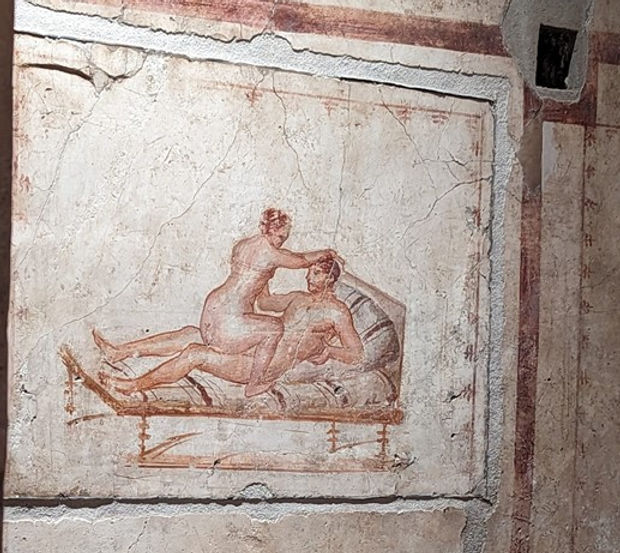
In using this new word arsenokoitai / "male-bedder", Paul could only have had in mind the abusive all-male sexual relationships then happening in Corinth and Ephesus that he needed to warn his congregation to avoid: primarily, slave-owners having anal intercourse with their slave-boys (or men) and older men with pederastic youths. All available historic evidence indicates those cities then knew of no faithful monogamous sexual partnerships between men. And the first all-male marriage - between Emperor Nero and his castrated slave-boy Sporus - didn’t take place until 67 AD, 2 to 3 years after Paul died.
It’s like Paul had called out “gin-drinkers” if the only gin drank at the time were 90% proof, consumed neat just to get drunk. This would not be condemning today’s gin-drinkers drinking a single gin and tonic to unwind after work!

Very soon after Paul wrote, arsenokoitai had evolved to describe more powerful men exploiting others economically, often without any sex involved. (This has some parallels with the similar English word "bugger", which originally referred to performing anal intercourse on (usually) another man, but which evolved in slang to also mean to "take advantage of" someone). The rapid evolution of "arsenokoitai" to mean general non-sexual abuse and exploitation surely confirms that the type of acts Paul was describing by this word must have been abusive, exploitative homoerotic acts – the very sort we know were prevalent in his day. This seems to fit with most of the older English translations of arsenokoitai: “abusers of themselves with mankind” (KJV).
An accurate modern translation of arsenokoitai might be something like: men who sexually abuse boys and other men in having anal intercourse with them. I believe this is an obvious example of Paul’s second Thessalonian sexual ethic – do not take sexual advantage of another person (see 1 Thess. 4:3-7).
What these passages do not teach us
I've concluded that these two passages teach us nothing directly about the rights or wrongs of sex between two men in consensual equal monogamous partnerships, which were unknown in that time and place. They say nothing at all about sex between two women.
To sum up...
So, what I found was that these three New Testament "clobber" texts only condemn a certain form of male homoerotic sex - all-male anal intercourse carried out within promiscuous, lustful and abusive relationships. These seem to me clearly expressions of Paul’s key principles of sexual ethics in 1 Thessalonians 4:1-7: to not take sexual advantage of another person and to control your body sexually in a way that is holy and honourable, not in passionate lust like the pagans.
The evidence has convinced me that this has nothing to do with sex within loving monogamous gay partnerships today, which takes no advantage of anyone and, when kept between those two partners, is actually a means of controlling sexual desire.
Next stop ... press here to explore the Old Testament "clobber" texts.