A Tale of Two Clerics “Choosing to Grow in Love” Jason’s Story Part One Shorter Version


This is a summary of my main post and full interview with Jason that you can read here: A Tale of Two Clerics "Choosing to Grow in Love" Jason’s Story Part One The Longer Read


Roy and Jason. Two Bible‑loving, Jesus‑centred Christians. Two men called into full‑time church ministry. Two men who happen to be gay. And yet their stories could not be more different.
Roy’s life was built on a foundation that was destined for collapse the moment he fell in love with another man in his 40s. His very public outing in 1999 was as brutal as it was inaccurate. The fallout cost him his ministry, his family, and the life he had spent decades building. Though God has restored good things to his life- especially his now 27-year partnership with Chris - he still carries the scars of that life-crash.
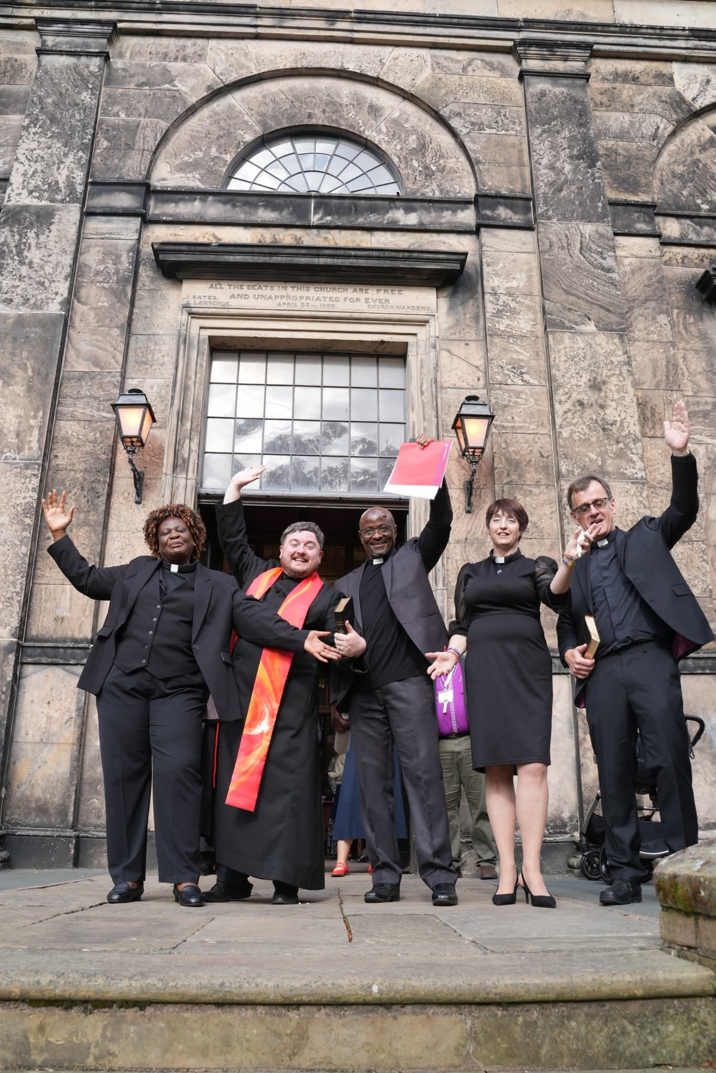
Jason’s story, by contrast, shows what happens when love is allowed to grow rather than be crushed. He met Ben as a teenager. They fell in love young, grew up together, and in 2022 they were married in their own church. Their life and ministry together have become a blessing not only to each other but to their church, their community, and now to their adopted son, Luke.
These two stories—one marked by harm, the other by flourishing—illustrate something profoundly biblical. The New Testament repeatedly calls us to discern truth by its fruit: what promotes good and what avoids harm.

Jesus himself taught this (Luke 6:6–11), and the early church lived it (Acts 10–15). On my website, I describe this as the ultimate test of Christ’s love (See part 5 of my Tests section: https://www.affirmingevangelical.uk/tests ). When we apply that Christ‑centred test to the question of same‑sex relationships, Roy’s and Jason’s lives speak volumes.
Two Eras, Two Worlds
Roy was born in 1946—into a Britain where homosexuality was criminalised, pathologised, and persecuted.

A post‑war “moral panic” led to thousands of prosecutions of gay men for “gross indecency”. Swept up in that morale maelstrom was Alan Turing – the brilliant mathematician who helped crack the Nazi’s Enigma Code. Because of his homosexuality, he was convicted, chemically castrated, and, in 1954, driven to suicide, aged only 41.

His tragedy was emblematic of the era Roy grew up in. Even when the Wolfenden Report recommended decriminalisation in 1957, only 25% of the public supported it. The law didn’t change until 1967—the year Roy graduated and turned 21.

The church of Roy’s youth reflected the culture around it. “Homosexuality” was seen simply as a sin some were “prone to,” with no understanding that same‑sex orientation might be part of a person’s created identity. A 1965 poll found 93% of the public believed homosexuality was a sickness. That was the world in which Roy’s beliefs were formed..
Jason, was born in 1993 and so entered a very different Britain.

The infamous section 28 ban on “promoting homosexuality” still lingered, but attitudes were thawing. Activism by Stonewall, OutRage! and others challenged homophobia. Public opposition to same‑sex relationships fell below 50% by 2000. Legal reforms followed: equalised age of sexual consent (2000), adoption rights (2002), repeal of Section 28 (2003), civil partnerships (2005). By the time Jason and Ben met in 2009, 63% of the public already supported same‑sex marriage. And in 2014, the year Jason reached 21 and graduated, the law finally caught up with public opinion and allowed same-sex marriage.

The church lagged behind, but even there change was stirring. Progressive evangelicals like Steve Chalke began re‑examining Scripture. Influential books— especially James Brownson’s Bible, Gender, Sexuality (2013) and Matthew Vines’ God and the Gay Christian (2014)—helped many, like me, rethink long‑held assumptions about homosexuality and same-sex relationships.

And then there were the Methodists—years ahead of most. Their 1993 “Derby Resolutions” affirmed the ministry of gay and lesbian Christians. By 2006 they permitted same-sex civil partnerships for their ministers. By 2014 they had affirmed same‑sex marriages, although even they weren’t quite ready to host such weddings.

This was the church that welcomed Jason and Ben as teenagers, embraced them as a couple, and nurtured Jason’s call to ministry.
Roy never got the chance for his church to accept him as a gay man, let alone as part of a same-sex couple. Jason got both. And the fruit of those two environments could not be more different.
Jason’s Story: Growing Up, Growing in Love, Growing in Christ
What follows is drawn from my interview with Jason—a gentle, thoughtful, deeply Christ‑centred minister whose life bears witness to the goodness of love allowed to flourish. (See the full interview in the second section of my longer piece here: A Tale of Two Clerics "Choosing to Grow in Love" Jason’s Story Part One The Longer Read )
Childhood: Ordinary Joys, Quiet Questions
Jason describes his childhood as “a mixture of both happiness and struggle". There were the ordinary everyday joys of a good, stable family life, and there was always music—his ever-happy place. But there was also an unnamed sense of difference. Growing up outside a church context, he didn’t have spiritual language for his inner life, nor did he have words for his emerging sexuality. Like many gay people, he sensed he was “different” long before he understood why.


When asked whether anything in his childhood “made” him gay, Jason is clear: no. “I believe this is simply the way God made me,” he says. Psalm 139’s declaration that we are “fearfully and wonderfully made” includes his sexuality. “Being gay is not a wound in my story. It is part of the gift of who I am.”

Realising He Was Gay
Like many, Jason first became aware of his sexuality around age 13. It wasn’t a dramatic revelation—more a gradual recognition that his emotional and physical attractions were toward boys, not girls. His friendships with girls were “warm and meaningful”, but they never carried “the emotional and physical pull” he felt toward boys. “Attraction wasn’t theoretical,” he says. “It was emotional, physical, and undeniable.”
Meeting Ben: "Teenage Sweethearts"
Jason and Ben met at Sixth Form College—Jason was 16, Ben 17. Like many young couples, their relationship grew out of friendship. Over time, that friendship deepened into love.

Jason had only two brief teenage romances before Ben. Ben, remarkably, made a promise early on—much like the one I myself made to my own future spouse Hannah when I was 17—that one day he would marry Jason. This was 2009, five years before same‑sex marriage became legal. So, it was an act of faith as much as love. And in 2022, he fulfilled that promise.
Being “Outed” by a Love Letter
Jason didn’t have a dramatic “coming out moment.” But his mum did find a love letter from Ben when Jason was 16 and Ben 17 or 18. This was the very same letter where Ben declared his hope to marry him one day. Over time, both families came to love and accept them as they were as individuals and as a couple. Their mutual stability, love, faithfulness, and now their journey into adoptive parenthood have only deepened that acceptance.

Facing Hostility—and Receiving Grace
Jason experienced the usual schoolyard cruelty directed at anyone perceived as “different.” As an adult, hostility has been subtler—especially in church contexts. But the church is where sexual theology became personal. Some people have made assumptions or expressed discomfort simply because he and Ben exist as a couple.
But Jason is quick to emphasise the grace he has known. The Methodist Church has been a place of extraordinary affirmation. Their acceptance as adoptive parents was also a profound confirmation of their shared life and vocation.

School, Music, and the Gift of Creativity
Understandably, Jason disliked the social politics of school—the pressure to fit a mould. But he loved music. Music became a place where he felt fully himself, a language for emotions he didn’t yet have words for. It remains his “happy place,” whether in worship, performance, or directing.

He wonders whether some of his traits—empathy, creativity, emotional expressiveness—may have been shaped by growing up gay. Not because gay people share universal traits, but because living with difference often deepens one’s sensitivity, especially towards others who feel marginalised.
Faith: Meeting Jesus Through Community
Jason didn’t grow up in church. His journey to faith began through relationships—especially a Methodist Local Preacher who accompanied him for his A‑Level music exam and invited him to play at a Christian Aid concert. He joined the music rota, then found himself attending even when he wasn’t scheduled. Over time, he encountered Jesus not just intellectually but spiritually—through worship, Scripture, prayer, and the witness of others.
That journey eventually led him into ordained ministry in the Methodist Church, where faith, justice, community, and pastoral care are woven together.
Jesus: The Pattern of His Life
“Jesus is not simply an idea to me,” Jason says. “He is the pattern of my life—the One who reveals what God is like.” Ministry shapes his daily living. Faith is not abstract theology but lived discipleship: in marriage, in adoption, in preaching, in community.

I resonate deeply with that. Too many evangelicals (myself included) have sometimes reduced faith to a tick box of orthodox beliefs rather than discipleship. Jason’s life is a reminder that Jesus calls us not simply to admire him but to follow him.
Homophobic Teaching—and a Better Way
Jason has encountered church teaching that frames same‑sex relationships as inherently sinful. “That was painful,” he says. “Not because I reject Scripture, but because I love it!” His response has not been to walk away but to stay, serve, and witness to a more generous, Christ‑centred reading of Scripture.

He believes the Bible must be read as a whole, through the lens of Christ. The few passages often cited do not describe loving, covenanted same‑sex relationships as we understand them today. Scripture consistently upholds covenant, fidelity, justice, and love. Jason believes same‑sex marriage can embody those virtues—and, I believe, his own marriage is a living testimony to that truth.
Although Jason would not own the label “evangelical”, his theological beliefs entirely align with my own and fit the Evangelical Alliance’s Basis of Faith, with just one exception – like me, and like the late great evangelical John Stott, Ben does not believe eternal conscious torment of anyone reflects the character of Christ. He is a “hopeful universalist”, whereas I am more of a “Calvinist" universalist. (For more of our discussion about where we stand on evangelical theology, please see the final section of my full interview with Jason here: A Tale of Two Clerics "Choosing to Grow in Love" Jason’s Story Part One The Longer Read )
Love, Faithfulness, and Growing Together
Jason has no regrets about settling down with Ben so young . “Growing together has been one of the greatest gifts of my life,” he says. Love isn’t about “playing the field”"; love is about “choosing each other again and again.” After nearly 42 years with Hannah, I couldn’t agree more.


Like any couple, Jason and Ben notice and are attracted by other people—they’re human. But their relationship is built on trust, honesty, and faithfulness. That commitment matters deeply to them.
A Story of Love Allowed to Flourish

Jason’s story is not simply a “gay story.” It's a human story, a Christian story. A story of grace, calling, discipleship, and covenant love. A story of what happens when the church chooses welcome over fear, affirmation over suspicion, and Christ‑centred love over inherited prejudice. It shows the good fruit that comes when we embrace gay people’s God-wired sexuality and need for a same-sex life‑partner. And it's this good fruit that shows how faithful, covenanted same-sex relationships meet Scripture's ultimate truth test of Christ’s love.


Comments