A Tale of Two Clerics – “A Different Life” Roy Clements’ Story, Part 4 1999 to 2026 Shorter Version

Updated: Mar 25


This is a summary of my full article and interview with Roy which you can read here: A Tale of Two Clerics "A Different Life" Roy Clements' Story Part 4 1999-2026 The Longer Read
27 years of change – in all our lives
The 27 years between Roy’s public “outing” in 1999 and today have seen huge global changes most of us can plot in our own lives.
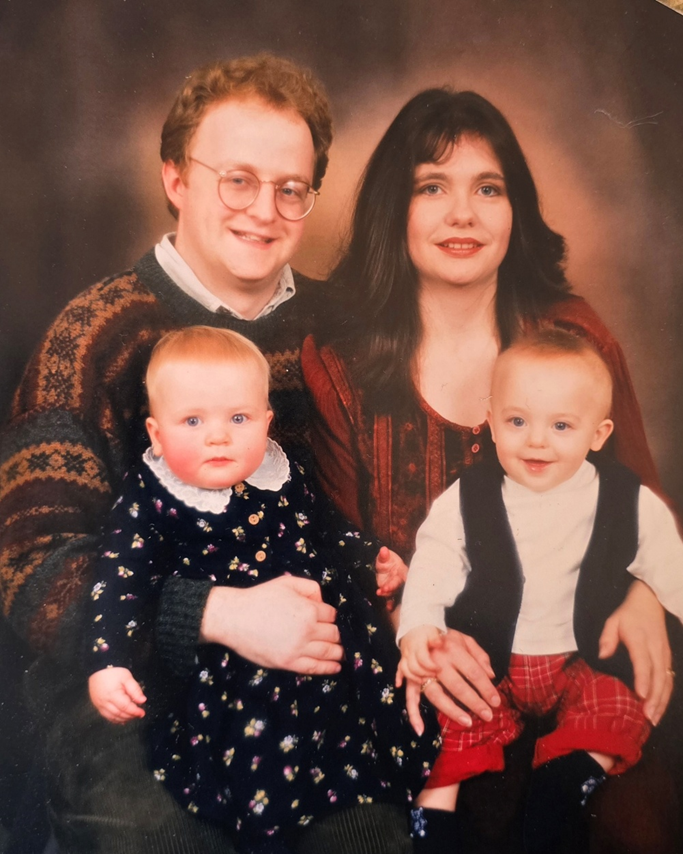
In 1999, Hannah and I were young parents of two‑year‑old boy‑girl twins, trading up from our three-bed end‑terrace to a four‑bed detached house. It cost £163,000—just over eight times the average salary and four times my own. I’d also recently bought a mostly useless Ericsson A1018s mobile phone: it could occasionally make calls, but even texting was beyond its powers! We had no home computer, no internet, and when we finally did get online the following year, it was through painfully slow dial‑up.

Work life was almost as analogue. My law firm had recently adopted email, but most communication still happened through typed letters, phone calls, face‑to‑face meetings and yellow‑paper faxes. Filing cabinets lined the walls. Every day meant a suit and tie in my own little office. At home I was still buying CDs, having only recently abandoned vinyl. Politically we were New Labour voters, but theologically were still small‑c conservative evangelicals. I held tightly to traditionalist “biblical” views on “homosexuality” and women’s roles. So, when I heard that Roy Clements—the great preacher who’d baptised Hannah—had “left his wife for another man,” I was deeply shocked. Only later did I learn how inaccurate and simplistic that narrative was.
Fast‑forward 27 years. Those tiny twins are now young adults themselves. I’ve swapped my hairy head and clean-shaven chin for a hairy chin and clean-shaven head!

We’re finally looking to leave the house our twins grew up in. It’s now worth nearly four times what we paid—and sixteen times the average salary. Even on my own very good wage, I couldn’t afford the mortgage to buy it today, just as most young families can’t. And that hand-size bit of plastic we still call a mobile phone is the device through which we manage almost the entire house‑moving process. It’s also now the conduit through which I stream all the music I could ever want. My CDs are now long gone.

My work is paperless, almost entirely online and mostly from home. I usually “see” people through Teams calls. When I do go into the office I just wear jeans and a smart-casual shirt. I hot‑desk in open plan, docking-in the same tablet I use at home. And I’m now a solar‑panelled, EV‑driving member of the Green Party!

I’d like to think I’m more committed to Jesus and His word than ever—but now as a progressive, affirming, universalist evangelical. A combination I once thought impossible! That journey led me to create this website in support of same‑sex marriage, and ultimately to reconnect with Roy Clements and share the deeper lessons of his story—of which this is the final part.
27 Years of Change – in Same‑Sex Relationships
Between 1999 and 2026, acceptance of homosexuality and same‑sex relationships advanced dramatically across Europe, North America, and much of the world, despite pockets of fierce resistance or even retrenchment, especially in Africa.
In 2001, the Netherlands became the first nation to legalise same‑sex marriage.

Belgium followed in 2003, Spain and Canada in 2005, South Africa in 2006, and Norway and Sweden in 2009. The UK moved more slowly but eventually recognised civil partnerships in 2005 and same‑sex marriage in 2014. The U.S. followed in 2015 with the Supreme Court’s Obergefell ruling. By early 2026, 38 countries recognised same‑sex marriage, including Thailand, the first in Southeast Asia.
These legal changes reflected a profound shift in public attitudes. In 2000, UK opinion was evenly split on whether same‑sex relationships were acceptable. By the mid‑2020s, 78% expressed positive approval.
The church’s journey has been far more turbulent. In 1999, almost no major denomination sanctioned same‑sex marriage. By 2026, several mainstream Protestant churches did so, including the Church of Scotland, many Baptist churches (beginning with Bloomsbury in 2016), and the Methodist Church from 2022. One of the first Methodist same‑sex weddings was that of Ben and Jason McMahon‑Riley, whose story I’ll highlight in my next two posts.

From 2023, both the Catholic Church and the Church of England permitted informal blessings for same‑sex couples, though neither recognised such unions as marriage. Progress in the Church of England remains painfully slow, with clergy in same‑sex civil partnerships still officially required to remain celibate.
27 Years of Change – in Roy’s Life
A Quick Recap
On 30 September 1999, Roy Clements’ distinguished evangelical career was destroyed overnight by an article in The Times, outing him as gay under the inaccurate headline “Preacher leaves wife for man.” The leak likely came from Sir Fred Catherwood, then President of the Evangelical Alliance and a trusted friend. The real story was far more complex and painful. Yet, God still worked powerfully through Roy in the years leading up to his “outing”. He had planned to leave his current Christian ministry that year, but his carefully planned new career - as a voice in the growing debate about Christianity and Science – was trashed before it had even started. See here my previous part 3 of Roy’s story: https://www.affirmingevangelical.uk/post/a-tale-of-two-clerics-the-rise-and-fall-of-roy-clements-r
Banished from his home, family, church, and vocation, Roy was forced into an entirely new life. But Jesus did not abandon him. Not only did he go there with Him, but he brought Roy a new life‑partner to walk the journey with him. What follows is the final part of Roy’s story in his own words.
Q & As with Roy Clements


How, why and when did your relationship with Chris resume?
“In autumn 1999, I had to make an urgent decision about what I was going to do with the rest of my life now that my ambition to do the Masters degree had collapsed… I discovered a one-year course at Strathclyde university … Teaching English as a Foreign Language (TEFL). I also thought Scotland was remote enough from Cambridge to confound the Daily Mail and Daily Mirror reporters who were still looking for me.”
At the same time, he learned that Chris’s own relationship had ended and that Chris too had been thrown out of his home. Roy continues: “With considerable trepidation, I asked him whether he would come to Glasgow with me. That the last 26 ½ years have been by far the happiest period of my life is entirely down to the fact that he said ‘Yes’!”

Was the relationship really celibate at that time?
“I’m not sure how the Times would define ‘celibacy’ in the context of a homosexual relationship?… Briefly, you are right. In autumn 1999, Chris and I began life together as a ‘normal’ gay couple… It was wonderful to enter the new millennium together.”
How did you rebuild your life after your public outing and “cancellation”?
Roy enrolled in the TEFL course at Strathclyde while Chris continued research at Glasgow University. After a year, Chris secured a well‑paid teaching post in London, prompting their move south. Roy soon found part‑time work teaching academic English at Imperial College, eventually gaining a permanent post and remaining until retirement in 2016. “Chris took to teaching like a duck to water. He has developed an immensely successful career, eventually becoming Head of a large Economics department at a leading public school.”
What effect did your outing have on the relationship with your children?
Roy’s answer is heart-breaking:
“I have never had an opportunity to talk about what happened to my children… my younger son was deliberately removed from the house when I returned to collect my books… I did write to them at Christmas and birthdays for a number of years… But it is immensely sad to report that since my departure in 1999 I have had only a single very brief and unhappy message from my middle son.”
How has your relationship with Chris evolved? Why does it work?
“Like any couple, we have had our ups and downs… But our love is deep. And the bumpy road which our relationship had to negotiate in its early days has, I think, made it very resilient.”
Roy wishes to protect Chris’s privacy but has kindly provided me with this silhouette he’d drawn of the two of them.

Roy explains: “Chris is a bit of a fashionista! He has a lot of hats … and jackets … and shirts … and shoes! Sigh!”
What challenges arise from your 20-something age gap?
“We have known one another now for 33 years… Chris was a young and rather vulnerable Chinese student when we met… For his part, he has had to adapt to a partner who is gradually growing old. Now I am nearly 80, I depend on him a very great deal.”
Why did you wait until 2015 to enter a civil partnership?
“We felt entirely emotionally secure [without any legal formalities]… The decision… was taken at the time of my retirement purely for reasons of financial prudence.”
Why not marry instead, since it became legal in 2015?
“We have never felt any need to use the language of marriage… We made private promises of lifelong fidelity to one another on a weekend in Paris long ago. They have been adhesive enough to keep us together … Following Paul’s irenical advice in Romans 14… I prefer to refrain from needlessly offending traditionalist believers… The label ‘marriage’ is not important enough for me to fight about it.”
But should the term “marriage” not just be reserved for a union between a man and a woman?
“Marriage is a creation ordinance that belongs to all mankind irrespective of culture or religion. Societies define and enact ‘marriage’ in different ways; all are equally valid…. If parliament passes a law that applies the word to a same-sex couple, then I see no grounds for denying that they are ‘married’….
However, the water has been muddied by the longstanding tradition in many western countries of conducting marriages in church. I believe this is a mistaken hangover from the sacramentalism of medieval Catholicism. ...
Frankly, I am perfectly happy that a same-sex couple can now call their covenant relationship a ‘marriage’. It is simply a word – ‘a rose by any other name would smell as sweet’. Unfortunately, this trivial semantic issue has been conflated with the much more important debate over whether that same-sex couple are offending God simply by being together.”
Have you and Chris found a church community that accepts you?
“No – and this is mainly my fault… The churches which would affirm us… are in general either theologically liberal or… ‘post‑evangelical’. The reformed churches I used to serve… find me an embarrassment.”
What are your views on current church debates over LGBTQ+ issues ?
“Evangelical Christians are one of a rapidly diminishing number of pockets of homophobic prejudice that still remain in British society.”
Roy credits Stonewall and LGCM for liberating thousands, including himself, but laments that conservative evangelical churches remain largely unchanged. He predicts a coming schism in the Church of England over same‑sex marriage and gay clergy, and wishes evangelicals would divide over “the person and work of Christ” rather than sexuality.
On transgender issues, Roy says: “unlike Stonewall (and you, Jeremy), I am ‘gender critical’. … sex is a biological property that identifies the vast majority of human individuals as either male or female from birth … a very small number suffer from… ‘gender dysphoria’… However, I believe these are very rare exceptions.”
He argues that conflating LGB and T issues has caused confusion and division, noting that the previous leader of LGCM, Richard Kirker, has now joined the LGB Alliance, which deliberately omits the “T.”
Has becoming affirming led you into liberal theology?
Roy answers firmly:
“My theological position today has not significantly changed. A long article on my website entitled ‘Why I am still an Evangelical Christian’ is the best answer to your question. (See https://royclements.net/papers/ - under the “Theological” section). I believe the importance of the gay question has been grossly exaggerated. It properly belongs with other ethical issues of conscience, like divorce, abortion, and war, on which evangelicals should be able to agree to differ.”
I would heartily encourage anyone reading this post to dive for pearls in Roy’s sermon archive at : https://royclements.net/archive/


Comments